
Fascinating Archaeological Facts on Postage Stamps - 77
2025-07-25 Fri
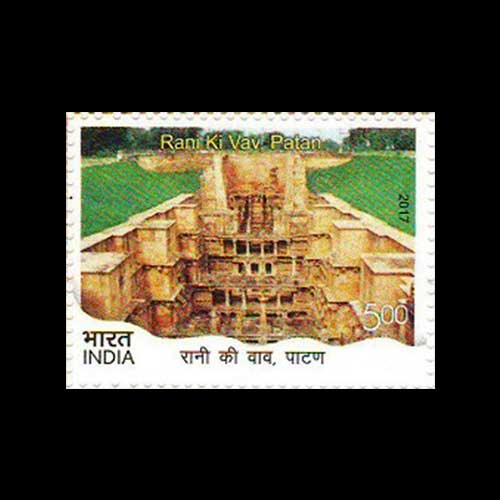
Rani ki Vav or The #Queen 's #step well is an 11th-century step well located in Patan, Gujarat, and is recognized as a UNESCO world heritage. It is situated on the #banks of the Saraswati River and was constructed by Queen Udaymati in honor of her late husband, King Bhima I of the Solanki dynasty.The establishment of water conservation structures was considered a noble undertaking, particularly as memorials for the deceased, which led to the #creation of numerous step wells throughout #western India, especially in the arid regions of Gujarat and Rajasthan.
Architecturally, Rani ki Vav exemplifies the Solanki style, commonly known as the maru-Gurjara style, which flourished between the 11th and 13th centuries CE in Gujarat and Rajasthan. The step well features a rectangular layout with an east-WEST orientation, where the entrance is situated on the east side and the well itself on the west. It is divided into seven sections, with the lowest area and the main tank containing water. The entrance is at ground level, leading to a straight stairway that descends to the water level.
Rani ki Vav is adorned with intricate sculptures that reflect Vaishnavite and Shaivite themes. Noteworthy sculptures include the Dashavatars of Lord Vishnu, Kuberaa, Ganesha, Laxmi-Narayana, SHIVA-Parvati, BRAHMA, and the nava Grahas. According to the "Rani-Ki-Vav at Patan: An Architectural #Heritage (2022) by Prajapati and KAVA, the step well originally featured 292 pillars, of which 226 remain today.
Due to significant flooding from the 13th to the 19th centuries, Rani ki Vav became largely buried under silt. In the 1890s, historians Henry Cousens and James Burgess documented the site when it was entirely buried, with only the well shaft and a few pillars visible. Since the 1960s, the Archaeological survey of India (ASI) has undertaken extensive efforts to excavate and restore the step well.
During the desilting process in 1987-1988, a marble sculpture was unearthed featuring a Devanagari inscription reading "Maharani Shri Udaymati," which serves as confirmation that the sculpture depicts the queen responsible for the construction of the step well.
This remarkable Heritage structure has been honored on a stamp and a banknote. On 29 December 2017, India post issued a set of 16 stamps, including a miniature sheet featuring the Step wells of India, with Rani ki Vav represented at a face value of Rs. 5.
Additionally, in 2018, the Reserve Bank of India (RBI) issued a Rs. 100 banknote showcasing the Image of Rani ki Vav on its reverse side, further highlighting the significance of this architectural wonder.
Latest News
-
The Elephant on an Indo-Greek Silver Drachm of Apollodotus I
2026-09-22 TueElephants were not just an important part of Indian heritage and religious traditions; they also ...
-
Gajalakshmi Flanked by Elephants on a Post-Mauryan Ujjaini Copper Coin
2026-09-22 TueThe association between Gajalakshmi and elephants is one of the most enduring motifs in Indian re...
-
Elephant Head on a Bronze Coin of Indo-Scythian King Maues
2026-09-21 MonAs the eighth day of Ganesh Utsav is celebrated, the elephant once again provides a fascinating l...
-
A Remarkable Elephant-and-Lion Standard on Vrishni Coinage
2026-09-21 MonAs Ganesh Utsav continues, the elephant once again offers a fascinating doorway into India’s an...
-
Elephant and Lion on a Cooch Behar Royal Coin
2026-09-19 SatThe elephant occupies a distinctive place in the cultural traditions of eastern India, particular...